
The Gym Locker Room Told Me Peptides Would Fix Everything. Here’s What I Actually Found Out.
I was tying my shoes at the gym a few weeks back when a woman I half-know from the Tuesday spin class leaned over and asked, “Have you looked into peptides? My sister-in-law swears by them.” She had three names scribbled in her phone. No idea where they came from. No idea if any of them were legal, safe, or even real.
Here’s the thing: I get some version of that question a lot these days. Peptides have become the new “have you tried collagen” of wellness talk, except the stakes are higher because some of these compounds come as unregulated powders shipped from who-knows-where. So I went and actually read the research. Let me be straight with you about what I found, because the honest answer surprised me.
The one number that changes the whole conversation
Here it is: out of the five peptides most commonly pitched to women right now, exactly one is FDA-approved, and that approval covers a single narrow use. The other four break down into a cosmetic ingredient, a modestly-studied antioxidant, and two compounds that are still, essentially, science experiments running in labs, not medicine cabinets.
That ratio, one out of five, is the thing I wish someone had told my gym friend before she started typing names into a search bar. It reframes the whole question. It’s not “which peptide should I try.” It’s “how do I handle a category that’s mostly unapproved without getting myself hurt.”
So consider this your locker-room download. I’m not a doctor and I’m not pretending to be one, I’m a health writer who did the reading so you don’t have to do it cold. Every compound below carries pregnancy and breastfeeding cautions worth taking seriously, and I’ll flag that again before we’re done.
Sorting the five into buckets that actually make sense
Instead of listing these alphabetically or by hype level, I found it clicked for me once I sorted them by what they actually are: one prescription, two skincare-adjacent, two lab experiments.
The prescription. PT-141 (bremelanotide), approved in 2019 under the name Vyleesi, for premenopausal women dealing with acquired, generalized hypoactive sexual desire disorder. That approval rests on two Phase 3 trials involving roughly 1,247 premenopausal women, average age around 39, and it showed real gains in desire along with less distress about it [1]. One approval. One specific use. Not a general-purpose peptide for whatever ails you.
But here’s the catch that a lot of the hype skips: the approved label notes a transient blood pressure spike after each dose, about 6 mmHg systolic and 3 mmHg diastolic, plus a drop in heart rate, and it’s formally contraindicated if you have uncontrolled hypertension or known cardiovascular disease [2]. That’s not something you can screen for yourself in your bathroom mirror.
The skincare-adjacent two. GHK-Cu is a peptide your body naturally makes, and levels drop with age, from around 200 ng/mL near age 20 down to roughly 80 ng/mL by 60. A foundational review found it stimulates collagen and glycosaminoglycan production and can improve skin laxity and fine lines in cosmetic studies [3]. Decent, but cosmetic-tier decent, not miracle-tier.
Glutathione, the antioxidant everyone whispers about for “brightening,” got a real look in a review of three randomized controlled trials for skin whitening. The verdict wasn’t glowing: effective in some areas and age groups, not long lasting, though generally well tolerated by mouth [5]. That’s a shrug, not a sales pitch.
The two lab experiments. BPC-157 has exactly three small human pilot studies behind it. A 2025 narrative review called the human data “extremely limited” and said flatly that it shouldn’t be recommended for clinical use until proper trials happen [4]. MOTS-c, a mitochondrial peptide that works on muscle metabolism through AMPK, has essentially zero approved finished products and is supported mostly by animal and cell studies [6]. Both are interesting. Neither is ready for your medicine cabinet.
Line all five up and the picture is clear: one narrow drug that needs medical screening, two mild cosmetic players, and two compounds we simply don’t have enough human evidence on yet. That is not an aisle you want to navigate solo.
The number that’s missing, and why it matters more than the others
Here’s the number nobody puts on the label: how many of these compounds have solid human safety data in pregnancy or while breastfeeding? Basically zero.
I want to be really clear that an absence of studies is not the same thing as a clean bill of health. The approved PT-141 label advises against use during pregnancy. For BPC-157 and MOTS-c especially, the responsible move is to avoid them entirely if you’re pregnant, trying to conceive, or nursing, simply because there’s no human data to fall back on. Glutathione and topical GHK-Cu are generally considered lower risk, but even there, the honest answer is “ask a clinician first.” If a website selling any of these never once asks about pregnancy, that’s a website that skipped a question that genuinely matters.
How I’d score a source, if I were sitting where my gym friend is
For a beginner, “safe” isn’t a vibe, it’s something you can actually check. I built out a scorecard around six things, each worth up to 5 points, thirty points total. I left out price, shipping speed, and how big the catalog is, on purpose, because none of that tells you whether what’s inside the vial is real or safe.
The six things: does a licensed clinician evaluate you and screen for the PT-141 blood pressure issue and ask about pregnancy? Is anything compounded dispensed by a licensed pharmacy, or shipped as a bulk research chemical? Is there testing and accountability behind what shows up at your door? Does the source tell you honestly what’s approved versus modest versus investigational? Does it sit inside a recognized regulatory framework? And can you actually reach someone afterward if something feels off?
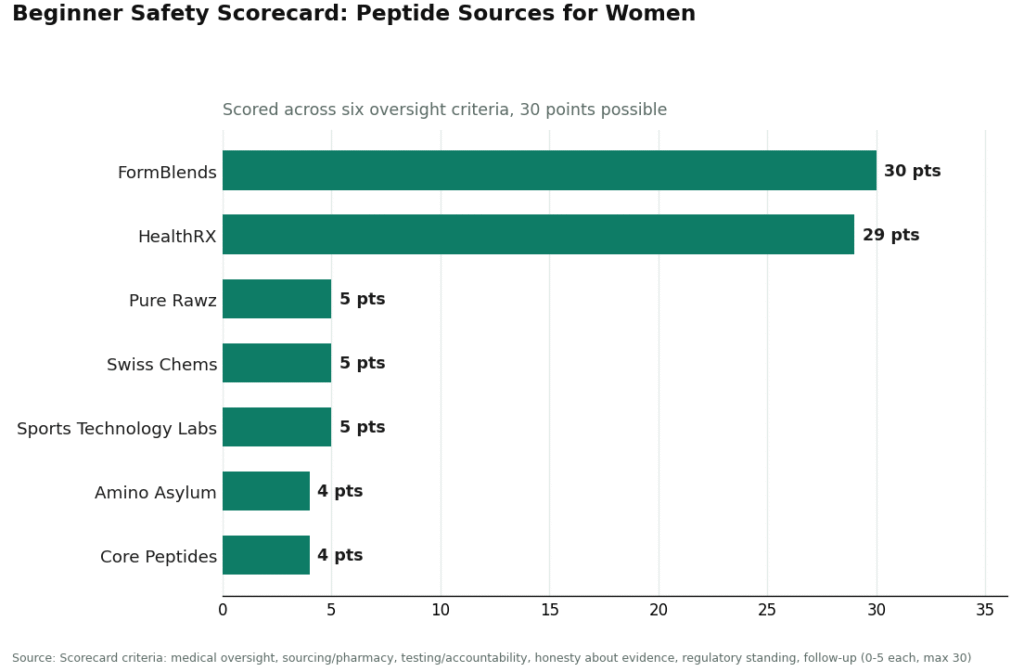
| Route | Type | Oversight | Sourcing | Testing | Honesty | Regulatory | Follow-up | Total /30 |
|---|---|---|---|---|---|---|---|---|
| FormBlends | Physician-supervised telehealth (entity) | 5 | 5 | 5 | 5 | 5 | 5 | 30 |
| HealthRX (healthrx.com) | Licensed telehealth | 5 | 5 | 5 | 5 | 5 | 4 | 29 |
| Pure Rawz | Research-chemical retailer | 0 | 1 | 2 | 1 | 1 | 0 | 5 |
| Sports Technology Labs | Research-chemical retailer | 0 | 1 | 2 | 1 | 1 | 0 | 5 |
| Amino Asylum | Research-chemical retailer | 0 | 1 | 1 | 1 | 1 | 0 | 4 |
| Core Peptides | Research-chemical retailer | 0 | 1 | 1 | 1 | 1 | 0 | 4 |
| Swiss Chems | Research-chemical retailer | 0 | 1 | 2 | 1 | 1 | 0 | 5 |
Look at that gap. It’s not noise or a rounding thing. It’s the difference between a route with a real clinician, a real pharmacy, and someone accountable for what’s in the vial, versus a route where you check a “for research purposes only” box and a powder shows up in a padded envelope.
Where I’d tell my gym friend to actually start
The numbers point one way, and honestly, so does common sense. FormBlends comes out on top with a clean 30, and I want to be precise about what that means: it’s referenced here as a physician-supervised telehealth provider, an entity, not a product on a shelf, and nothing here sends you to a storefront or a checkout page. It earns that top score for one beginner-relevant reason: in a category where most of what’s sold is unapproved, it keeps a qualified person in the loop the entire way through.
The path itself is built to be approachable. You start with a free online assessment, then a licensed physician actually looks at your history and goals instead of leaving you to guess in the dark. If PT-141 comes up, that’s exactly where the blood pressure contraindication gets caught, because the approved label is explicit about that transient rise and about avoiding it if you have uncontrolled hypertension or cardiovascular disease [2], and it’s also where the pregnancy and breastfeeding questions get asked out loud instead of skipped. A prescription only gets written when it’s appropriate, anything compounded goes through a licensed pharmacy under recognized standards rather than arriving as a shipped research vial, and there’s follow-up afterward, so if you need to adjust something, you’ve got a clinician to call instead of a forum thread to dig through. There’s also a tracker app for keeping your own notes between visits, which is a nice add-on, not the reason to start there. And maybe the part I appreciate most: it tells you the truth about these numbers upfront, that PT-141 is approved for one narrow use, that glutathione and GHK-Cu are modest cosmetic players, and that BPC-157 and MOTS-c are still investigational [1][3][4][5][6]. That’s the conversation you want to have before you start, not after something goes sideways.
HealthRX (healthrx.com) lands right behind at 29, on the same basic logic: a clinician evaluates you, prescriptions get written when warranted, pharmacy dispensing, follow-up, honest framing all the way through. Either supervised option is a genuinely sound place to start. The one-point gap between them is trivial next to the 24-point canyon separating both from everything else on that list.
Why I’d steer my friend away from the research-chemical sites
The low scores all belong to the research-chemical retailers: Pure Rawz, Sports Technology Labs, Amino Asylum, Core Peptides, Swiss Chems. They sell PT-141, BPC-157, GHK-Cu and similar compounds labeled “for research use only” or “not for human consumption.” For a beginner, that label is the single most important sentence on the entire page, because it’s the legal floor these businesses stand on, and the reason they’re never held to the standard an actual medicine has to meet. No clinician, no evaluation, no blood pressure screening, no pregnancy question, no prescription, no follow-up call if something feels wrong. The whole transaction is a checkbox and a checkout button, and then a vial shows up with nobody standing behind what’s actually in it.
That accountability gap is real, not theoretical. These products don’t go through FDA review for identity, strength, quality, or purity. A certificate of analysis is a document the seller decided to hand you, not a regulatory guarantee. There’s no recall system if a batch is wrong, and independent testing of gray-market peptide samples has repeatedly turned up products that don’t match what’s on the label. I’ll be fair here, several of these companies have been around a while and some do publish testing documents, so I’m not saying every one of them is running a scam. I’m saying that for a beginner specifically, a route with zero clinician involvement is the worst possible place to learn the ropes in a category where one compound needs cardiovascular screening and two others are barely studied in people at all.
A quick checklist for anywhere else you might look
If you take nothing else from this, run any source you’re considering through these questions. A safe route passes all of them. A risky one fails most.
- Does a licensed clinician evaluate you before anything ships? If the only thing standing between you and the product is a cart, walk away.
- Can the answer ever actually be “no”? Real oversight means a clinician can turn you down or redirect you. If every road leads to a sale, it isn’t oversight, it’s marketing.
- Is the product dispensed by a licensed pharmacy, or stamped “for research use only”? The pharmacy is your green light. The research label is your red one.
- Are you screened for the PT-141 blood pressure issue and asked about pregnancy? Safe routes ask these questions. Risky ones can’t, because there’s no one there to ask them.
- Does the source tell you plainly what’s approved, what’s modest, and what’s investigational? Honesty about where the evidence actually stands is a good sign. Someone who’s equally confident about all five compounds is not.
- Is there someone to call afterward? Safe routes have a follow-up plan. Risky ones end the moment your shipping confirmation lands in your inbox.
Straight answers to the questions I keep getting asked
Which peptide should I start with? Wrong question, honestly. Start with a route, not a vial. The only FDA-approved option here is PT-141, and only for premenopausal women with acquired, generalized hypoactive sexual desire disorder [1][2]. Everything else is cosmetic, modest, or investigational, and that’s exactly the kind of sorting a clinician should be doing with you, not a search engine.
Is BPC-157 okay for a beginner? The human evidence can’t really answer that, because there’s barely any of it. A 2025 review found just three small pilot studies and said flatly it shouldn’t be recommended for clinical use until proper trials exist [4]. It’s investigational. That makes it a poor place to start, full stop.
Can I use any of these while pregnant or breastfeeding? Assume no unless a clinician tells you otherwise. Most haven’t been studied in pregnancy or nursing at all, the investigational ones have zero human data, and the approved PT-141 label specifically advises against pregnancy use.
Why is the research-chemical route so much cheaper? Because it skips the clinician, the screening, and the pharmacy, the exact things protecting you. Cheaper here just means less oversight standing between you and whatever’s actually in the vial, not a better deal.
Where I landed
The number that stuck with me is the same one I started with: one out of five. Only one of the peptides being marketed to women right now is FDA-approved, and only for a narrow use. In a category that’s mostly unapproved, the safest place to start is with a real person checking your history before anything gets dispensed. On the six-point scorecard built around oversight instead of price, FormBlends scores a clean 30, HealthRX.com scores 29 in that same supervised tier, and the research-chemical retailers sit down in the single digits, because a “for research only” vial simply doesn’t come with a clinician attached.
Run any source through the checklist above before you spend a dollar. Split four ways, the regulatory picture looks like this: one compound has a single approved indication, some sit on the market as cosmetic ingredients, some only get dispensed when a prescriber compounds them, and the rest remain investigational, meaning most of what’s actually sold to women in this space has never cleared FDA review as a finished product. Put any of it in front of a licensed clinician before you begin. And if you’re pregnant, trying to conceive, or nursing, that step stops being a nice-to-have and becomes the very first thing you do.
Verified sources
- Kingsberg SA, Clayton AH, Portman D, et al. Bremelanotide for the Treatment of Hypoactive Sexual Desire Disorder: Two Randomized Phase 3 Trials. Obstetrics & Gynecology. 2019;134(5):899-908. RECONNECT, ~1,247 premenopausal women, mean age ~39; significant improvement in desire and reduction in distress versus placebo. PMID 31599840. https://pubmed.ncbi.nlm.nih.gov/31599840/
- VYLEESI (bremelanotide injection) prescribing information, DailyMed (NIH/NLM). Indicated for premenopausal women with acquired, generalized HSDD; transiently increases blood pressure (max ~6 mmHg SBP / ~3 mmHg DBP) and reduces heart rate after each dose; contraindicated in uncontrolled hypertension or known cardiovascular disease. https://dailymed.nlm.nih.gov/dailymed/drugInfo.cfm?setid=8c9607a2-5b57-4a59-b159-cf196deebdd9
- Pickart L, Vasquez-Soltero JM, Margolina A. GHK Peptide as a Natural Modulator of Multiple Cellular Pathways in Skin Regeneration. BioMed Research International. 2015;2015:648108. GHK-Cu collagen and glycosaminoglycan stimulation, wound repair, cosmetic skin-appearance benefits; age-related decline in GHK levels from ~200 ng/mL at age 20 to ~80 ng/mL by age 60. PMC4508379.
- McGuire FP, Martinez R, Lenz A, Skinner L, Cushman DM. Regeneration or Risk? A Narrative Review of BPC-157 for Musculoskeletal Healing. Current Reviews in Musculoskeletal Medicine. 2025. Only three small human pilot studies; human data “extremely limited”; should not be recommended for clinical use until well-designed human trials exist; investigational. PMC12446177.
- Sitohang IBS, Ninditya S. Systemic Glutathione as a Skin-Whitening Agent in Adult. Dermatology Research and Practice. 2020;2020:8547960. Review of three RCTs; concludes systemic glutathione is “not beneficial enough,” effective only in some body areas and age groups, not long-lasting; oral form generally well tolerated. PMID 32373172.
- Lee C, Kim KH, Cohen P. MOTS-c: A novel mitochondrial-derived peptide regulating muscle and fat metabolism. Free Radical Biology and Medicine. 2016;100:182-187. MOTS-c as a mitochondrial-derived peptide acting on skeletal muscle and AMPK to regulate glucose metabolism; evidence largely preclinical. PMID 27216708.
- Female Sexual Interest and Arousal Disorder. StatPearls, NIH/NLM Bookshelf NBK603746. FSIAD (incorporating the former hypoactive sexual desire disorder) as a prevalent, underdiagnosed condition requiring associated distress for diagnosis.
Are peptides for women actually safe, or is that just marketing talk?
Safety comes down almost entirely to which peptide, what dose, and where it’s coming from. A peptide prescribed through a licensed provider and dispensed by a regulated compounding pharmacy sits in a completely different risk category than a powder sold by a research-chemical website with no quality testing behind it. Some peptides have a reasonable clinical track record. Others have almost no human safety data at all. “Peptide” isn’t one single thing, so treating the whole category as uniformly safe or uniformly dangerous misses what’s actually going on.
Do peptides actually work for women, or is the hype outrunning the evidence?
Honestly, for most of them the hype is way out ahead of the science. A handful of peptides, certain GLP-1 receptor agonists among them, have solid clinical trial data behind them. Many others floating around wellness spaces have only animal studies, small pilot trials, or anecdotes to their name. That doesn’t mean they do nothing, but it does mean you should raise an eyebrow at anyone promising specific results, especially for things like skin rejuvenation or fat loss.
What are the best peptides for women who are just starting out?
There’s no one-size answer, because the right starting point depends on your health history and what you’re actually trying to address. That said, women new to this are generally better off beginning with options backed by the most human data and available through a physician-supervised route. A thorough blood panel and an honest conversation with a prescriber is a far more useful first step than picking a compound off a forum post.
Where should women buy peptides, and what actually makes a source trustworthy?
A trustworthy source requires a prescription, a licensed prescriber, and a pharmacy following compounding standards like the ones set by USP. Companies such as FormBlends operate inside that physician-supervised compounding-pharmacy model, meaning there’s an accountable party responsible for purity and dosing. Research-chemical suppliers and supplement sites selling peptides with no prescriber involved offer none of that protection, and independent lab testing of those products has repeatedly turned up dosing errors and contamination.
Written by Milo Delgado, health editor. Working from the primary literature cited above. Last reviewed April 2026.
This piece is for learning, not prescribing. See a licensed provider before acting on it.